Write your solutions to the following problems either by writing them on a piece of paper or on a tablet and scanning your answers as a PDF. Note that you are not allowed to use LaTeX, Google Docs, or any other digital document creation software to type your answers. Homeworks are due to Pensive by 11:59PM on the due date. See the syllabus for details on the slip day policy.
Homework will be evaluated not only on the correctness of your answers, but on your ability to present your ideas clearly and logically. You should always explain and justify your conclusions, using sound reasoning. Your goal should be to convince the reader of your assertions. If a question does not require explanation, it will be explicitly stated.
We’d like to get your feedback on how the course has been going so far!
You will find a survey at this link. It is not anonymous — we need to know your identity to give you homework credit for it, and so that you can give us feedback that we can reply to (if you’d like).
Please fill out the survey AFTER you’ve finished the rest of Homework 3. When submitting to Pensive, it does not matter which page of your submission you assign to Problem 1; we will enter survey completion credit in manually.
Thank you for your feedback — it’s helping shape our brand-new course.
Problem 2: Line Dancing (15 pts)
a)
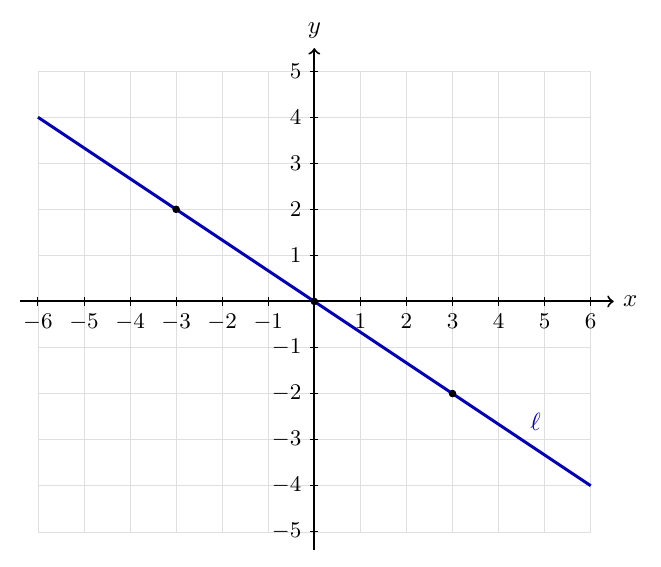
(5 pts) The line \(\ell\) shown below passes through the origin. Find a nonzero vector \(\vec{v}\) lying on \(\ell\). Use this vector to express \(\ell\) in parametric form, as we did in Chapter 2.1.
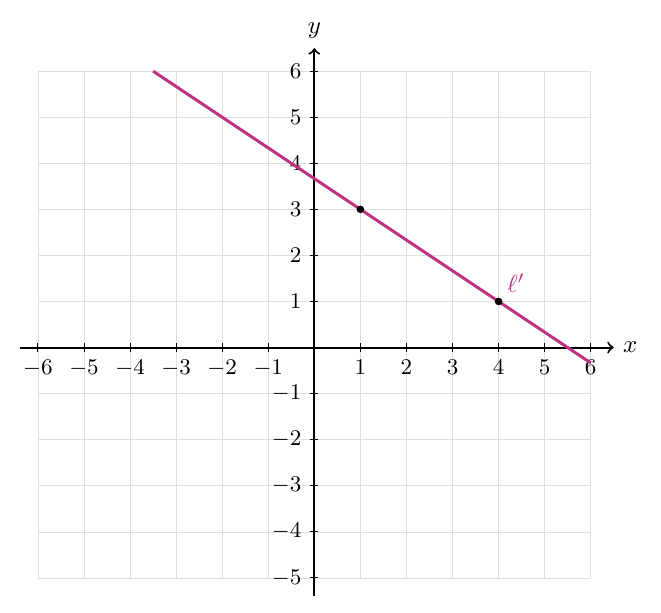
(10 pts) The affine line \(\ell’\) shown below is parallel to \(\ell\).
i.
(5 pts) Find a vector \(\vec{v}_0\) whose endpoint lies on \(\ell’\). Use \(\vec{v}_0\) and your vector \(\vec{v}\) from part (a) to express \(\ell’\) in parametric form.
Let \(\ell\) and \(\ell’\) be the lines from Problem 2.
a)
(6 pts) First, let’s work with \(\ell\), the line through the origin.
(i)
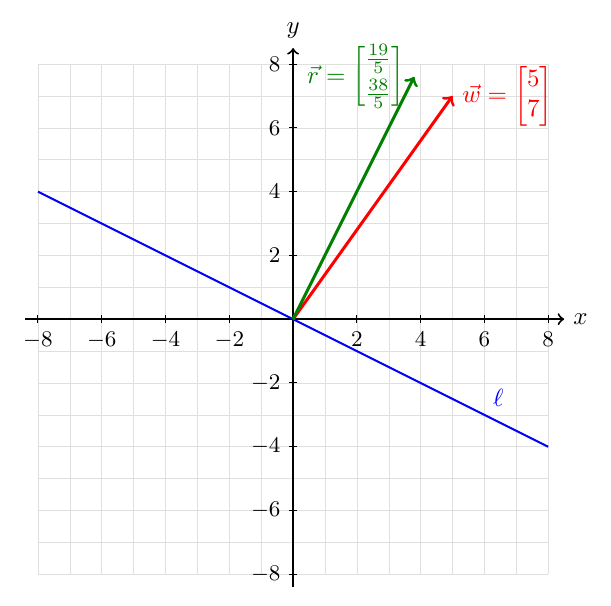
Find a nonzero vector \(\vec{w}\) that is normal to \(\ell\); that is, \(\vec{w}\) lies on \(\ell^\perp\) (the line through the origin that is perpendicular to \(\ell\)).
(ii)
Use \(\vec{w}\) to express \(\ell\) as an equation in dot-product form.
(iii)
Finally, express \(\ell\) as a linear equation in terms of \(x\) and \(y\) (with no vectors).
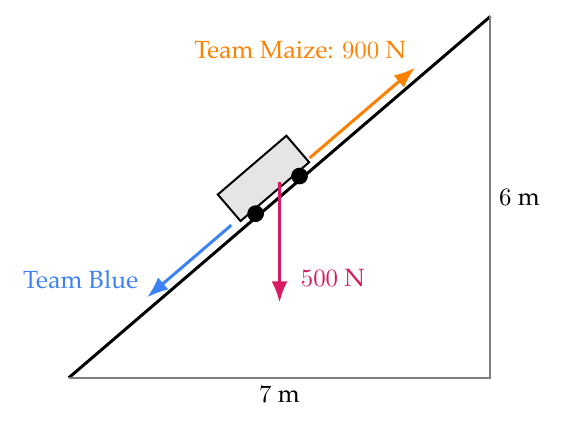
A heavy equipment cart with a weight of \(500\) Newtons (N) rests on a frictionless inclined ramp. For every \(7\) meters of horizontal distance, the ramp rises \(6\) meters.
Team Maize stands uphill from the cart and pulls it up the ramp with a force of \(900\) N. Team Blue stands downhill from the cart and pulls it down the ramp. Both teams pull in directions parallel to the ramp.
a)
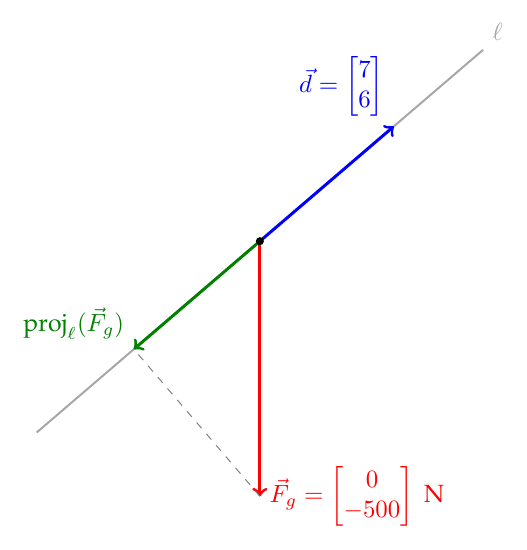
(8 pts) Find the component of the cart’s weight that acts parallel to the ramp. Give both its magnitude and its direction.
Most homeworks and some labs will have a Jupyter Notebook, containing Python code that supplements our understanding of the relevant mathematical ideas of the week.
You won’t need to submit the notebook anywhere. To get credit for the work you did in this notebook, include the following in your PDF submission to Homework 3 on Pensive, specifically under Problem 7:
1.
Task 1 (3 pts): A screenshot of the plot showing your two wind vectors.
2.
Task 2 (0 pts; but must complete): Nothing to submit.
3.
Task 3 (0 pts; but must complete): Nothing to submit.
4.
Task 4 (4 pts): A screenshot of your completed reconstruction code, plus a written response stating the sign of \(a\), using it to identify whether w = np.array([10, 0]) is a headwind or tailwind for Runway 24, and stating the crosswind magnitude \(|b|\).
5.
Task 5 (8 pts): Your written answers to both questions (4 pts each). No screenshots are required.