Each lab worksheet will contain several activities, most of which will involve writing math on paper, and some of which will involve running code in a Jupyter Notebook. Lab activities are meant to last an hour, and the second hour of lab is dedicated to starting the homework assignment. To receive credit for a lab, you must show your lab TA your work on both the lab worksheet and homework assignment.
While you must get checked off by your lab TA individually, we encourage you to form groups with 1-2 other students to complete the activities together.
\(\vec v\in\mathbb R^n\), pronounced “v in R n”, means that \(\vec v\) is a vector with \(n\) components. Usually, \(v_1,v_2,\ldots,v_n\) are placeholders for \(\vec v\)’s components.
A vector that results from scaling and adding one or more vectors is called a linear combination of the original vectors. For example, if \(\vec u=\begin{bmatrix}5\\1\end{bmatrix}\) and \(\vec v=\begin{bmatrix}1\\7\end{bmatrix}\), then \(2\vec u-3\vec v\) is a linear combination of \(\vec u\) and \(\vec v\). It is the new vector
$$ 2\vec u-3\vec v =2\begin{bmatrix}5\\1\end{bmatrix}-3\begin{bmatrix}1\\7\end{bmatrix} =\begin{bmatrix}10-3\\2-21\end{bmatrix} =\begin{bmatrix}7\\-19\end{bmatrix}. $$
For a vector \(\vec v\in\mathbb R^n\), its length, norm, or magnitude, is
Let \(\vec u=\begin{bmatrix}3\\4\end{bmatrix}\) and \(\vec v=\begin{bmatrix}-1\\-4\end{bmatrix}\).
a)
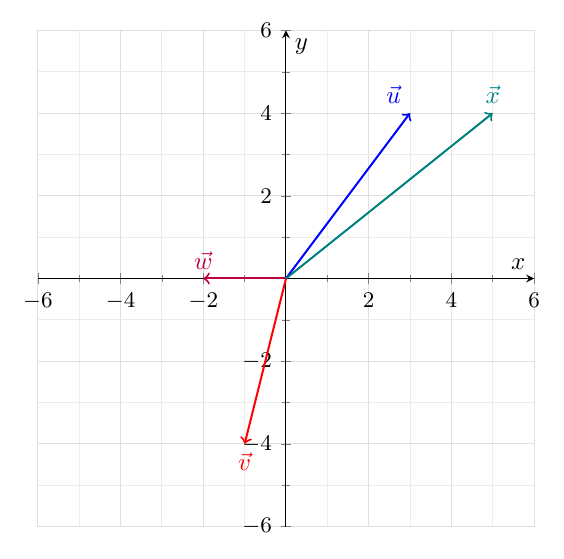
Let \(\vec w=-\vec u-\vec v\) and let \(\vec x=2\vec u+\vec v\). Draw \(\vec u\), \(\vec v\), \(\vec w\), and \(\vec x\) on the axes below, with each vector starting at the origin. Label each vector.
Solution
To find \(\vec w\) and \(\vec x\), we’ll scale the vectors and add their corresponding components:
$$ \begin{align*} \vec w &= -\vec u-\vec v = -\begin{bmatrix}3\\4\end{bmatrix}-\begin{bmatrix}-1\\-4\end{bmatrix} = \boxed{\begin{bmatrix}-2\\0\end{bmatrix}} \\ \vec x &= 2\vec u+\vec v = 2\begin{bmatrix}3\\4\end{bmatrix}+\begin{bmatrix}-1\\-4\end{bmatrix} = \boxed{\begin{bmatrix}5\\4\end{bmatrix}} \end{align*} $$
Each vector starts at the origin, so its components tell us where its tip goes. For instance, \(\vec w\) ends at \((-2,0)\), which is 2 units to the left of the origin.
b)
Which of the following vectors is equal to \(5\vec e_1-4\vec e_2\)? Select one option. Recall that \(\vec e_1=\begin{bmatrix}1\\0\end{bmatrix}\) and \(\vec e_2=\begin{bmatrix}0\\1\end{bmatrix}\) are the standard basis vectors in \(\mathbb R^2\).
Notice that the negative components of \(\vec v\) become positive when we square them. They tell us which way \(\vec v\) points, but its length is still positive.
Activity 2: The Dot Product
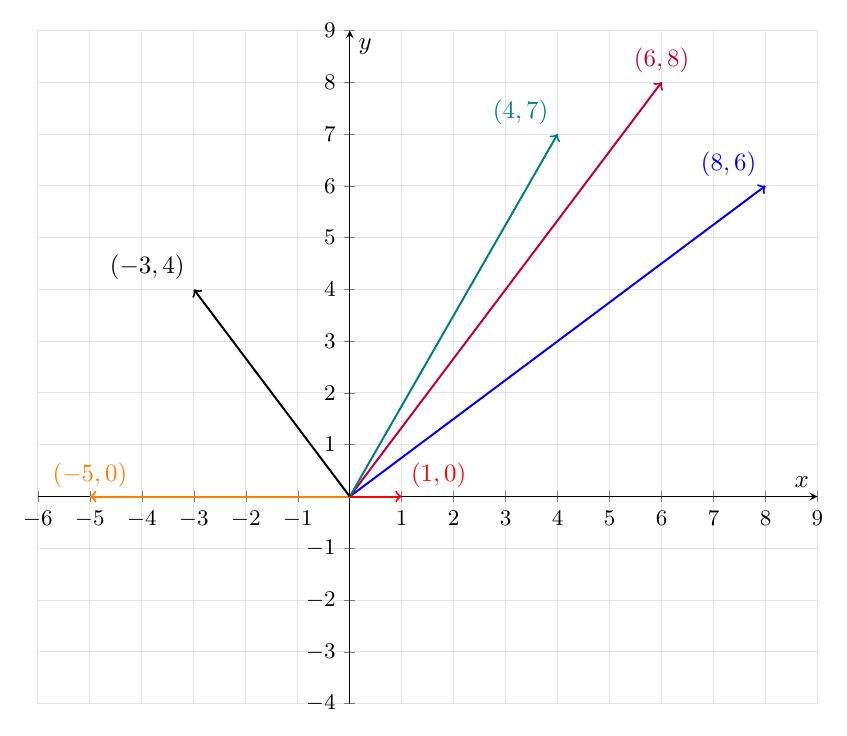
For each pair of vectors below, draw them on the axes, compute their dot product, and select whether the angle between them is acute, right, or obtuse. Draw each vector from the origin.
a)
\(\begin{bmatrix}8\\6\end{bmatrix}\) and \(\begin{bmatrix}1\\0\end{bmatrix}\)
Acute Right Obtuse
Solution
Acute. The dot product is:
$$ 8(1)+6(0)=\boxed{8} $$
Since it’s positive, the angle is acute.
b)
\(\begin{bmatrix}8\\6\end{bmatrix}\) and \(\begin{bmatrix}-5\\0\end{bmatrix}\)
Acute Right Obtuse
Solution
Obtuse. The dot product is:
$$ 8(-5)+6(0)=\boxed{-40} $$
Since it’s negative, the angle is obtuse.
c)
\(\begin{bmatrix}8\\6\end{bmatrix}\) and \(\begin{bmatrix}6\\8\end{bmatrix}\)
Acute Right Obtuse
Solution
Acute. The dot product is:
$$ 8(6)+6(8)=\boxed{96} $$
Since it’s positive, the angle is acute.
d)
\(\begin{bmatrix}8\\6\end{bmatrix}\) and \(\begin{bmatrix}4\\7\end{bmatrix}\)
Acute Right Obtuse
Solution
Acute. The dot product is:
$$ 8(4)+6(7)=\boxed{74} $$
Since it’s positive, the angle is acute.
e)
\(\begin{bmatrix}8\\6\end{bmatrix}\) and \(\begin{bmatrix}-3\\4\end{bmatrix}\)
Acute Right Obtuse
Solution
Right. The dot product is:
$$ 8(-3)+6(4)=\boxed{0} $$
Since it’s zero, the vectors are orthogonal.
Solution
Each pair contains \(\begin{bmatrix}8\\6\end{bmatrix}\), so we only need to draw that vector once. The labels below give the coordinates of each vector’s tip.
Why does the sign of the dot product tell us about the angle? Recall that:
Both lengths are positive here, so the dot product has the same sign as \(\cos\theta\). A positive dot product means the angle is acute, a negative dot product means it’s obtuse, and a zero dot product means it’s a right angle.
Activity 3: Angles and Orthogonality
Suppose \(\vec u=\begin{bmatrix}5\\0\\-4\\1\end{bmatrix}\) and \(\vec v=\begin{bmatrix}9\\1\\2\\3\end{bmatrix}\).
a)
Find \(\vec u\cdot\vec v\), \(\lVert\vec u\rVert\), and \(\lVert\vec v\rVert\).
Solution
For the dot product, we multiply corresponding components and add the results:
The calculations work just as they did in \(\mathbb R^2\); we now have four components to work with.
b)
Using the results of part a), find the angle between \(\vec u\) and \(\vec v\). Leave your answer in the form \(\cos^{-1}(\cdot)\).
Solution
We know the dot product and both lengths from part a). To find the angle, we’ll substitute them into the geometric definition of the dot product and solve for \(\theta\):
defines the angle between them. Another term for the cosine of the angle between two nonzero vectors is their cosine similarity.
Activity 4: Comparing Vectors
As we saw in the previous activity, the cosine similarity of two nonzero vectors is the cosine of the angle between them. It is one of the many ways we can measure how “different” two vectors are, by comparing their directions.
This is the cosine of the angle between the vectors. Since it’s positive, the angle is acute.
b)
Another way to measure how “different” two vectors are is to measure the distance between their tips when both vectors start at the origin. Find this distance for \(\vec u\) and \(\vec v\), that is, \(\lVert\vec u-\vec v\rVert\).
Solution
The distance is \(\boxed{\sqrt{29}}\).
The vector \(\vec u-\vec v\) tells us how to get from the tip of \(\vec v\) to the tip of \(\vec u\):
$$ \vec u-\vec v =\begin{bmatrix}2-(-2)\\1-4\\2-4\end{bmatrix} =\begin{bmatrix}4\\-3\\-2\end{bmatrix} $$