due by the end of class on Wednesday, September 16, 2026
Each lab worksheet will contain several activities, most of which will involve writing math on paper, and some of which will involve running code in a Jupyter Notebook. Lab activities are meant to last an hour, and the second hour of lab is dedicated to starting the homework assignment. To receive credit for a lab, you must show your lab TA your work on both the lab worksheet and homework assignment.
While you must get checked off by your lab TA individually , we encourage you to form groups with 1-2 other students to complete the activities together.
Classify each linear equation as homogeneous or inhomogeneous .
a)
\(3x-4y=0\)
Solution
A linear equation in two variables is homogeneous if it can be written in the form
$$ ax+by=0. $$
Otherwise, it is inhomogeneous.
b)
\(x+2y=5\)
Solution
c)
\(2x-y=0\)
Solution
d)
\(x-4y+7=0\)
Solution
Let
$$ \vec{v} = \begin{bmatrix} 2\\ -3 \end{bmatrix} . $$
a)
Write \(\operatorname{span}(\vec{v})\) explicitly in set-builder notation.
$$ \operatorname{span}(\vec{v}) = \Big\{ \hspace{11cm} \Big\}. $$
Solution $$ \operatorname{span}(\vec{v}) = \left\{ t \begin{bmatrix} 2\\ -3 \end{bmatrix} : t\in\mathbb{R} \right\}. $$
Equivalently,
$$ \operatorname{span}(\vec{v}) = \left\{ \begin{bmatrix} 2t\\ -3t \end{bmatrix} : t\in\mathbb{R} \right\}. $$
b)
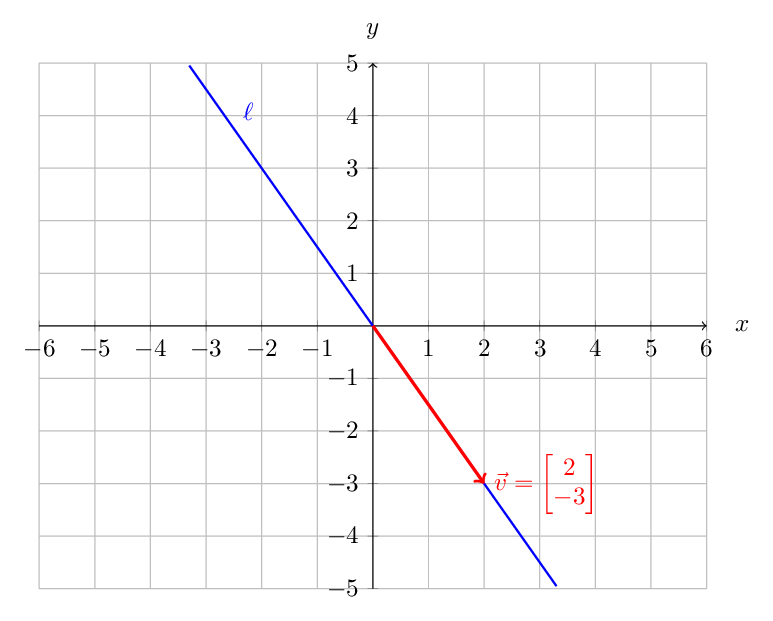
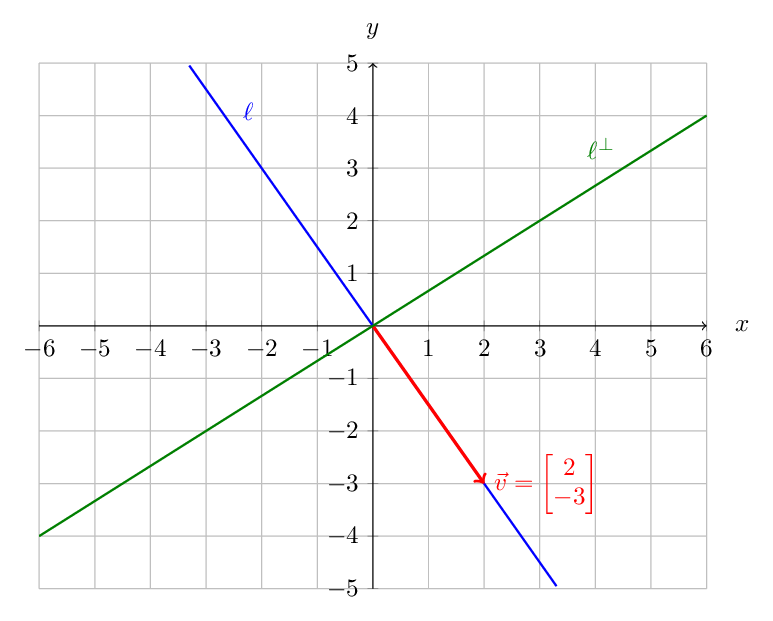
Draw \(\operatorname{span}(\vec{v})\) on the coordinate plane below. Label the line \(\ell\) , and mark the vector \(\vec{v}\) .
Solution The graph is the line through the origin with direction vector
$$ \begin{bmatrix} 2\\ -3 \end{bmatrix}. $$
Its equation is
$$ 3x+2y=0. $$
Let
$$ \vec{v}_0 = \begin{bmatrix} -2\\ 1 \end{bmatrix} \qquad\text{and}\qquad \vec{v} = \begin{bmatrix} 2\\ -3 \end{bmatrix}. $$
a)
Write
$$ \vec{v}_0+\operatorname{span}(\vec{v}) $$
explicitly in set-builder notation.
$$ \vec{v}_0+\operatorname{span}(\vec{v}) = \Big\{ \hspace{11cm} \Big\}. $$
Solution $$ \vec{v}_0+\operatorname{span}(\vec{v}) = \left\{ \begin{bmatrix} -2\\ 1 \end{bmatrix} + t \begin{bmatrix} 2\\ -3 \end{bmatrix} : t\in\mathbb{R} \right\}. $$
Equivalently,
$$ \vec{v}_0+\operatorname{span}(\vec{v}) = \left\{ \begin{bmatrix} -2+2t\\ 1-3t \end{bmatrix} : t\in\mathbb{R} \right\}. $$
b)
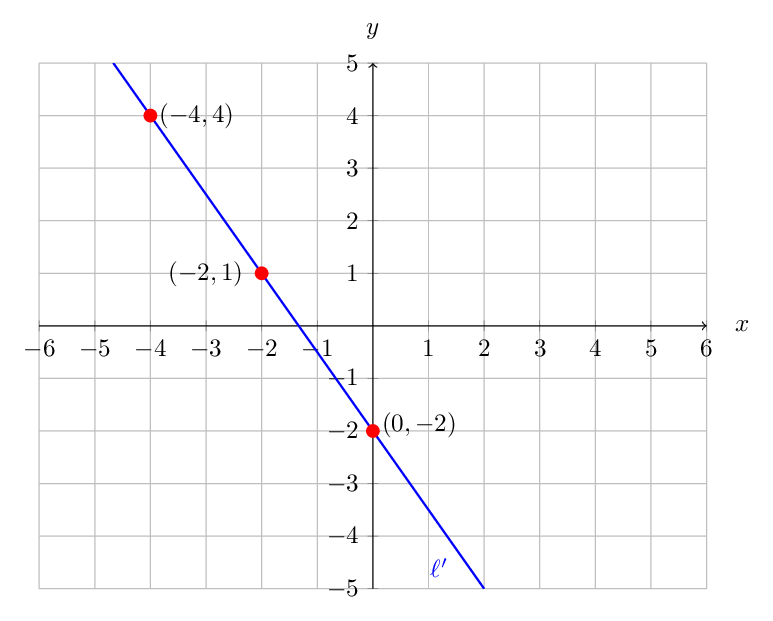
Draw this set on the coordinate plane below. Label the affine line \(\ell’\) and mark the points represented by \(\vec{v}_0\) , \(\vec{v}_0+\vec{v}\) , \(\vec{v}_0 - \vec{v}\) .
Solution The three requested points are
$$ \vec{v}_0 = \begin{bmatrix} -2\\ 1 \end{bmatrix}, $$
$$ \vec{v}_0+\vec{v} = \begin{bmatrix} -2\\ 1 \end{bmatrix} + \begin{bmatrix} 2\\ -3 \end{bmatrix} = \begin{bmatrix} 0\\ -2 \end{bmatrix}, $$
and
$$ \vec{v}_0-\vec{v} = \begin{bmatrix} -2\\ 1 \end{bmatrix} - \begin{bmatrix} 2\\ -3 \end{bmatrix} = \begin{bmatrix} -4\\ 4 \end{bmatrix}. $$
The affine line passes through these three points and is parallel to the line drawn in Activity 2. Its equation is
$$ 3x+2y=-4. $$
Let \(\ell\) be the line drawn in Activity 2:
$$ \ell = \operatorname{span} \left( \begin{bmatrix} 2\\ -3 \end{bmatrix} \right). $$
a)
i.
Recall that \(\ell^\perp\) is the line through the origin that is perpendicular to \(\ell\) . Draw \(\ell^\perp\) on the coordinate plane from Activity 2.
ii.
Find a nonzero vector \(\vec{w}\) on \(\ell^\perp\) .
$$ \vec{w} = \begin{bmatrix} \phantom{-00}\\ \phantom{-00} \end{bmatrix}. $$
iii.
Check that \(\vec{w}\) is perpendicular to \(\vec{v}\) :
$$ \vec{w}\cdot\vec{v} = \begin{bmatrix} \phantom{-00}\\ \phantom{-00} \end{bmatrix} \cdot \begin{bmatrix} 2\\ -3 \end{bmatrix} = $$
Solution For (i), drawing \(\ell^{\perp}\) on top of the graph from Activity 2 gives us:
For (ii), one possible choice is
$$ \vec{w} = \begin{bmatrix} 3\\ 2 \end{bmatrix}. $$
Indeed, we check at (iii) that
$$ \vec{w}\cdot\vec{v} = \begin{bmatrix} 3\\ 2 \end{bmatrix} \cdot \begin{bmatrix} 2\\ -3 \end{bmatrix} = 6-6 = 0. $$
Therefore,
$$ \ell^\perp = \operatorname{span} \left( \begin{bmatrix} 3\\ 2 \end{bmatrix} \right). $$
Thus, \(\ell^\perp\) is the line through the origin in the direction
$$ \begin{bmatrix} 3\\ 2 \end{bmatrix}. $$
Any nonzero scalar multiple of
$$ \begin{bmatrix} 3\\ 2 \end{bmatrix} $$
is also a valid choice for \(\vec{w}\) .
b)
Use \(\vec{w}\) and the dot product to write an equation for \(\ell\) .
i.
Equation in dot-product form:
$$ \vec{w}\cdot\begin{bmatrix} x\\ y \end{bmatrix} = \underline{\hspace{1cm}}. $$
ii.
Equation written explicitly in \(x,y\) coordinates:
Solution i.
Using
$$ \vec{w} = \begin{bmatrix} 3\\ 2 \end{bmatrix}, $$
the equation in dot-product form is
$$ \vec{w}\cdot \begin{bmatrix} x\\ y \end{bmatrix} =0. $$
Equivalently,
$$ \begin{bmatrix} 3\\ 2 \end{bmatrix} \cdot \begin{bmatrix} x\\ y \end{bmatrix} =0. $$
ii.
Written explicitly in coordinates, this is
$$ 3x+2y=0. $$
c)
Use \(\vec{v}\) and the dot product to write an equation for \(\ell^\perp\) .
i.
Equation in dot-product form:
$$ \vec{v}\cdot\begin{bmatrix} x\\ y \end{bmatrix} = \underline{\hspace{1cm}}. $$
ii.
Equation written explicitly in \(x,y\) coordinates:
Solution i.
Since \(\ell^\perp\) consists of the vectors perpendicular to \(\vec{v}\) , its equation in dot-product form is
$$ \vec{v}\cdot \begin{bmatrix} x\\ y \end{bmatrix} =0. $$
Equivalently,
$$ \begin{bmatrix} 2\\ -3 \end{bmatrix} \cdot \begin{bmatrix} x\\ y \end{bmatrix} =0. $$
ii.
Written explicitly in coordinates, this is
$$ 2x-3y=0. $$
Let \(\ell’\) be the affine line drawn in Activity 3:
$$ \ell' = \vec{v}_0+\operatorname{span}(\vec{v}), $$
where
$$ \vec{v}_0 = \begin{bmatrix} -2\\ 1 \end{bmatrix}, \qquad \vec{v} = \begin{bmatrix} 2\\ -3 \end{bmatrix}. $$
Use \(\vec{v}_0\) , the vector \(\vec{w}\) from Activity 4, and the dot product to write an equation for \(\ell’\) .
a)
First compute the constant on the right-hand side:
$$ \vec{w}\cdot\vec{v}_0 = \begin{bmatrix} \phantom{-00}\\ \phantom{-00} \end{bmatrix} \cdot \begin{bmatrix} -2\\ 1 \end{bmatrix} = \underline{\hspace{3cm}}. $$
Solution Using
$$ \vec{w} = \begin{bmatrix} 3\\ 2 \end{bmatrix} \qquad\text{and}\qquad \vec{v}_0 = \begin{bmatrix} -2\\ 1 \end{bmatrix}, $$
we obtain
$$ \begin{aligned} \vec{w}\cdot\vec{v}_0 &= \begin{bmatrix} 3\\ 2 \end{bmatrix} \cdot \begin{bmatrix} -2\\ 1 \end{bmatrix}\\ &= 3(-2)+2(1)\\ &= -6+2\\ &= -4. \end{aligned} $$
b)
i.
Find the equation in dot-product form:
$$ \vec{w}\cdot\begin{bmatrix} x\\ y \end{bmatrix} = \vec{w}\cdot\vec{v}_0 = \underline{\hspace{3cm}}. $$
ii.
Equation written explicitly in \(x,y\) coordinates:
Solution \(i\) From the previous subactivity,
$$ \vec{w}\cdot\vec{v}_0=-4. $$
Therefore, the equation in dot-product form is
$$ \vec{w}\cdot \begin{bmatrix} x\\ y \end{bmatrix} = -4. $$
\(ii\) Using
$$ \vec{w} = \begin{bmatrix} 3\\ 2 \end{bmatrix}, $$
this becomes
$$ \begin{bmatrix} 3\\ 2 \end{bmatrix} \cdot \begin{bmatrix} x\\ y \end{bmatrix} = -4. $$
Written explicitly in coordinates, the equation is
$$ 3x+2y=-4. $$
Which of the following pairs of vectors are orthonormal bases of \(\mathbb{R}^2\) ?
For each pair, compute the length of each vector and the dot product of the two vectors. Explain your answer.
a)
$$ \vec{u} = \begin{bmatrix} \frac{1}{\sqrt{5}}\\[2pt] \frac{2}{\sqrt{5}} \end{bmatrix}, \qquad \vec{v} = \begin{bmatrix} -\frac{2}{\sqrt{5}}\\[2pt] \frac{1}{\sqrt{5}} \end{bmatrix}. $$
$$ \lVert\vec{u}\rVert=\underline{\hspace{1.5cm}}, \qquad \lVert\vec{v}\rVert=\underline{\hspace{1.5cm}}, \qquad \vec{u}\cdot\vec{v}=\underline{\hspace{1.5cm}}. $$
Is \((\vec{u},\vec{v})\) an orthonormal basis?
Solution
For \(\vec{u}\) and \(\vec{v}\) to form an orthonormal basis of \(\mathbb{R}^2\) , both vectors must have length 1 and be perpendicular to each other (their dot product must be 0).
$$ \lVert\vec{u}\rVert = \sqrt{\frac15+\frac45} = 1, \qquad \lVert\vec{v}\rVert = \sqrt{\frac45+\frac15} = 1, $$
and
$$ \vec{u}\cdot\vec{v} = -\frac25+\frac25 = 0. $$
Therefore this pair is an orthonormal basis.
b)
$$ \vec{u} = \begin{bmatrix} \frac35\\[2pt] \frac45 \end{bmatrix}, \qquad \vec{v} = \begin{bmatrix} \frac45\\[2pt] \frac35 \end{bmatrix}. $$
$$ \lVert\vec{u}\rVert=\underline{\hspace{1.5cm}}, \qquad \lVert\vec{v}\rVert=\underline{\hspace{1.5cm}}, \qquad \vec{u}\cdot\vec{v}=\underline{\hspace{1.5cm}}. $$
Is \((\vec{u},\vec{v})\) an orthonormal basis?
Solution
$$ \lVert\vec{u}\rVert=1, \qquad \lVert\vec{v}\rVert=1, $$
but
$$ \vec{u}\cdot\vec{v} = \frac{12}{25}+\frac{12}{25} = \frac{24}{25}\neq 0. $$
Both vectors are unit vectors, but they are not orthogonal. Therefore, this pair is not an orthonormal basis.
c)
$$ \vec{u} = \begin{bmatrix} 2\\ -1 \end{bmatrix}, \qquad \vec{v} = \begin{bmatrix} 1\\ 2 \end{bmatrix}. $$
$$ \lVert\vec{u}\rVert=\underline{\hspace{1.5cm}}, \qquad \lVert\vec{v}\rVert=\underline{\hspace{1.5cm}}, \qquad \vec{u}\cdot\vec{v}=\underline{\hspace{1.5cm}}. $$
Is \((\vec{u},\vec{v})\) an orthonormal basis?
Solution
$$ \lVert\vec{u}\rVert=\sqrt{5}, \qquad \lVert\vec{v}\rVert=\sqrt{5}, $$
and
$$ \vec{u}\cdot\vec{v} = 2-2 = 0. $$
The vectors are orthogonal, but they are not unit vectors. Therefore, this pair is not an orthonormal basis.
Recall, only one of the three pairs \((\vec{u},\vec{v})\) from Activity 6 are an orthonormal basis of \(\mathbb{R}^2\) . Write those two vectors here again for your convenience.
$$ \vec{u}=\begin{bmatrix} \phantom{\dfrac{-00}{\sqrt{5}}}\\[6pt] \phantom{\dfrac{-00}{\sqrt{5}}} \end{bmatrix}, \quad \vec{v}=\begin{bmatrix} \phantom{\dfrac{-00}{\sqrt{5}}}\\[6pt] \phantom{\dfrac{-00}{\sqrt{5}}} \end{bmatrix}. $$
Now let
$$ \vec{x} = \begin{bmatrix} 4\\ -1 \end{bmatrix}. $$
Our goal in this activity is to write \(\vec{x}\) as a linear combination of \(\vec{u}\) and \(\vec{v}\) . That is, find scalars \(a\) and \(b\) such that
$$ \vec{x}=a\vec{u}+b\vec{v}. $$
Because \((\vec{u},\vec{v})\) is an orthonormal basis, the coefficients can be found using dot products:
$$ a=\vec{x}\cdot\vec{u}, \qquad b=\vec{x}\cdot\vec{v}. $$
Fill in the blanks below.
Compute \(a\) :
$$ \begin{aligned} a &= \vec{x}\cdot\vec{u}\\ &= \underline{\hspace{5cm}}. \end{aligned} $$
Compute \(b\) :
$$ \begin{aligned} b &= \vec{x}\cdot\vec{v}\\ \\ &= \underline{\hspace{5cm}}. \end{aligned} $$
Therefore,
$$ \vec{x} = \underline{\hspace{3cm}}\,\vec{u} + \underline{\hspace{3cm}}\,\vec{v}. $$
Solution The orthonormal basis from the previous activity is
$$ \vec{u} = \begin{bmatrix} \frac{1}{\sqrt{5}}\\[2pt] \frac{2}{\sqrt{5}} \end{bmatrix}, \qquad \vec{v} = \begin{bmatrix} -\frac{2}{\sqrt{5}}\\[2pt] \frac{1}{\sqrt{5}} \end{bmatrix}. $$
Since the basis is orthonormal, the coefficients are given by the dot products of \(\vec{x}\) with the basis vectors.
First,
$$ \begin{aligned} a &= \vec{x}\cdot\vec{u}\\ &= \begin{bmatrix} 4\\ -1 \end{bmatrix} \cdot \begin{bmatrix} \frac{1}{\sqrt{5}}\\[2pt] \frac{2}{\sqrt{5}} \end{bmatrix}\\ &= \frac{4}{\sqrt{5}}-\frac{2}{\sqrt{5}}\\ &= \frac{2}{\sqrt{5}}. \end{aligned} $$
Next,
$$ \begin{aligned} b &= \vec{x}\cdot\vec{v}\\ &= \begin{bmatrix} 4\\ -1 \end{bmatrix} \cdot \begin{bmatrix} -\frac{2}{\sqrt{5}}\\[2pt] \frac{1}{\sqrt{5}} \end{bmatrix}\\ &= -\frac{8}{\sqrt{5}}-\frac{1}{\sqrt{5}}\\ &= -\frac{9}{\sqrt{5}}. \end{aligned} $$
Therefore,
$$ \boxed{ \vec{x} = \frac{2}{\sqrt{5}}\,\vec{u} - \frac{9}{\sqrt{5}}\,\vec{v}. } $$
We can check the answer:
$$ \begin{aligned} \frac{2}{\sqrt{5}}\vec{u} - \frac{9}{\sqrt{5}}\vec{v} &= \frac{2}{\sqrt{5}} \begin{bmatrix} \frac{1}{\sqrt{5}}\\[2pt] \frac{2}{\sqrt{5}} \end{bmatrix} - \frac{9}{\sqrt{5}} \begin{bmatrix} -\frac{2}{\sqrt{5}}\\[2pt] \frac{1}{\sqrt{5}} \end{bmatrix}\\ &= \begin{bmatrix} \frac25\\[2pt] \frac45 \end{bmatrix} + \begin{bmatrix} \frac{18}{5}\\[2pt] -\frac95 \end{bmatrix}\\ &= \begin{bmatrix} 4\\ -1 \end{bmatrix}\\ &= \vec{x}. \end{aligned} $$