This page is meant to give you quick access to problems and their solutions. Refer to the original exam PDF, linked above, for test-taking instructions and formatting. Note that we’ve kept the problem text identical, which is why you may see things like “write your answer in the box below” despite there not being a box on this page.
Thus \(\boxed{\theta=\cos^{-1}(-5/6)}\). The dot product is negative, so the angle is obtuse (greater than \(90^\circ\)).
Problem 3 (15 pts)
Consider the line \(\ell\) in \(\mathbb R^2\) given by
$$ \begin{bmatrix}x\\y\end{bmatrix} =\begin{bmatrix}5\\3\end{bmatrix} +t\begin{bmatrix}6\\5\end{bmatrix},\qquad t\in\mathbb R $$
a)
(4 pts) Write an equation for \(\ell\) in the form \(ax+by=c\).
Solution
A normal \(\begin{bmatrix}a\\b\end{bmatrix}\) must be perpendicular to the direction \(\begin{bmatrix}6\\5\end{bmatrix}\), so \(6a+5b=0\). An easy choice is \(a=5\) and \(b=-6\); this comes from swapping \(6\) and \(5\) and negating one of them. Then, to find \(c\) in
$$ 5x-6y=c $$
just plug in a known point on the line, e.g., \((5,3)\):
$$ 5(5)-6(3)=7 $$
Therefore, one equation is \(\boxed{5x-6y=7}\). Other equations for this line are nonzero scalar multiples of this equation.
b)
(7 pts) Which of the following are valid scalar-parametric forms of \(\ell\)? Select all that apply. In each option, \(t\in\mathbb R\).
Select the second and third options. A parametrization describes \(\ell\) when its starting point lies on \(5x-6y=7\) and its nonzero direction is a scalar multiple of the original direction.
1.
Invalid: The direction is correct, but \((5,4)\) is not on \(\ell\): \(5(5)-6(4)=1\ne7\).
2.
Valid:\(5(11)-6(8)=7\), and the direction is twice the original direction.
3.
Valid:\(5(-1)-6(-2)=7\), and the direction is \(-3\) times the original direction.
4.
Invalid: The starting point is on \(\ell\), but the direction is perpendicular to the original direction, rather than parallel to it.
c)
(4 pts) Let \(\ell’\) be the line perpendicular to \(\ell\) that passes through \((7,-6)\). Write an equation for \(\ell’\) in the form \(ax+by=c\).
Solution
Because \(\ell’\) is perpendicular to \(\ell\), the direction of \(\ell\) is a normal to \(\ell’\). Thus \(\ell’\) has an equation \(6x+5y=c\). Substituting its point \((7,-6)\) gives
$$ c=6(7)+5(-6)=12 $$
One equation is \(\boxed{6x+5y=12}\).
Problem 4 (11 pts)
Let \(\vec u_1\) and \(\vec u_2\) form an orthonormal basis of \(\mathbb R^2\). Suppose
$$ \vec w=6\vec u_1+2\vec u_2. $$
a)
(4 pts) Find \(|\vec w|\).
Solution
Orthonormality gives \(|\vec u_1|=|\vec u_2|=1\) and \(\vec u_1\cdot\vec u_2=0\). Therefore,
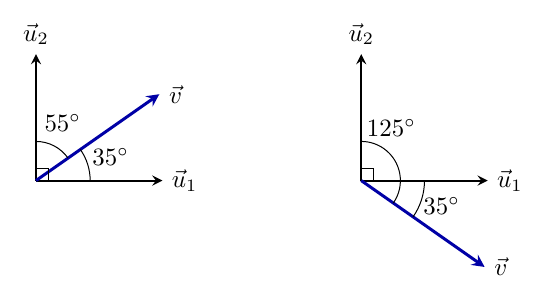
(4 pts) Suppose \(\vec v\) is another vector in \(\mathbb R^2\). Given that the angle between \(\vec v\) and \(\vec u_1\) is \(35^\circ\), which of the following could be the angle between \(\vec v\) and \(\vec u_2\)? Select all that apply.
The basis vectors \(\vec u_1\) and \(\vec u_2\) are perpendicular. We’re given that the angle between \(\vec v\) and \(\vec u_1\) is \(35^\circ\)—this could mean \(\vec v\) is \(35^\circ\) “below” \(\vec u_1\) or \(35^\circ\) “above” \(\vec u_1\).
The angles with \(\vec u_2\) are \(90^\circ-35^\circ=55^\circ\) and \(90^\circ+35^\circ=125^\circ\). These two pictures cover all possibilities up to rotation and reflection; the length of \(\vec v\) does not affect its angles.
Subtract the first equation from the second to get \(2a-2c=0\), or \(c=a\). Substitute into the first:
$$ 2a+5b+3a=0\quad\Longrightarrow\quad b=-a $$
Choose \(a=1\), giving \(\vec n=\begin{bmatrix}1\\-1\\1\end{bmatrix}\). The plane therefore has an equation \(x-y+z=d\). Its point \((6,-5,8)\) determines the constant:
$$ d=6-(-5)+8=19 $$
Thus \(\boxed{P:\ x-y+z=19}\). The two given directions are not scalar multiples, so they span a plane, and our normal is perpendicular to both.
b)
(8 pts) For each vector-parametric equation below, select whether it is a valid description of \(P\) and give a brief justification. In every option, \(s,t\in\mathbb R\).
Hint: Use the equation you found in the previous part.
Valid. The starting point is on \(P\), and \(\vec u+\vec v\) and \(\vec v\) span the same directions as \(\vec u\) and \(\vec v\): recover \(\vec u=(\vec u+\vec v)-\vec v\). Thus they still span the entire plane.
Valid. The new starting point satisfies \(9-(-4)+6=19\), so it lies on \(P\). The original two directions still span the plane; moving the starting point within \(P\) does not change the plane.
They provide only one independent direction, so this describes a line within \(P\), rather than the whole plane.
Problem 7 (10 pts)
The equations
$$ P_1:\ 5x+3y=10,\qquad P_2:\ 2x+6y+4z=20 $$
describe two planes in \(\mathbb R^3\). Write the set of common solutions to these two equations in vector-parametric form.
Solution
Method 1: Find a direction vector and a position vector. The intersection line lies in both planes, so its direction vector must be parallel to both planes. Thus it must be perpendicular to both normal vectors,
Therefore \(\vec v=a\begin{bmatrix}1\\-5/3\\2\end{bmatrix}\). We need a nonzero direction vector; choosing \(a=3\) gives \(b=-5\), \(c=6\), and \(\vec v=\begin{bmatrix}3\\-5\\6\end{bmatrix}\).
To find a position vector, find any one point that lies on both planes, so we know it is on their intersection line. Set \(y=0\). Then \(P_1\) gives \(5x=10\), so \(x=2\), and \(P_2\) gives \(4+4z=20\), so \(z=4\). Indeed,
$$ 5(2)+3(0)=10,\qquad 2(2)+6(0)+4(4)=20. $$
Thus we can use \(\begin{bmatrix}2\\0\\4\end{bmatrix}\) as a position vector, giving
Since \(x\) can be any real number, the common solutions are
$$ \begin{bmatrix}x\\y\\z\end{bmatrix} =\begin{bmatrix}0\\10/3\\0\end{bmatrix} +x\begin{bmatrix}1\\-5/3\\2\end{bmatrix},\qquad x\in\mathbb R $$
This is already a valid answer. To avoid fractions, multiply the direction vector by \(3\), which does not change the line. Choosing the point corresponding to \(x=2\) as our starting point gives
Equivalently, we have reparameterized by setting \(x=2+3t\). As \(t\) ranges over all real numbers, \(x\) does too, so we still describe the entire intersection line.
(6 pts) Find the orthogonal projection of \(\vec v\) onto \(P\).
Solution
The coefficients of \(P\) tell us that the vector \(\begin{bmatrix}4\\-5\\7\end{bmatrix}\) is perpendicular to \(P\). But \(\ell\) is the span of \(\begin{bmatrix}4\\-5\\7\end{bmatrix}\), so \(P\) and \(\ell\) are perpendicular, and \(\vec v\)’s projections onto \(\ell\) and onto \(P\) sum to \(\vec v\) exactly. Thus,